
Is Artificial Intelligence Supercharging Phishing, Deepfakes, and Online Fraud ?
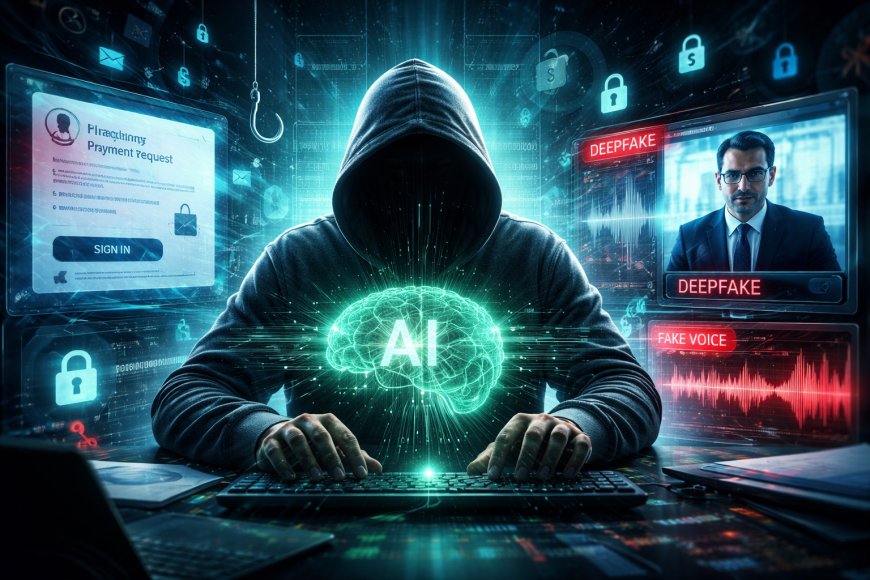
From hyper-realistic phishing emails to convincing deepfake videos and voice scams, cybercriminals are leveraging AI to automate, scale, and perfect their attacks like never before. What once required technical expertise and time can now be executed in seconds using generative AI tools.
This article explores how AI is transforming cybercrime, the most common attack methods, real-world implications, and—most importantly—how you can protect yourself.
What Is AI-Powered Cybercrime?
AI-powered cybercrime refers to malicious activities where attackers use artificial intelligence technologies—such as machine learning and generative AI—to enhance or automate cyberattacks.
Unlike traditional cyberattacks, AI-driven threats are:
- More personalized
- Harder to detect
- Faster to execute
- Scalable across thousands of victims simultaneously
This evolution is shifting cybersecurity from reactive defense to proactive intelligence.
1. AI-Generated Phishing: Smarter, Faster, More Dangerous
Phishing attacks are not new—but AI has made them dramatically more effective.
How AI Improves Phishing Attacks
AI tools can now:
- Analyze social media profiles to craft personalized messages
- Mimic writing styles of CEOs or colleagues
- Generate flawless emails in multiple languages
- Create realistic fake websites instantly
Example Scenario
Imagine receiving an email from your manager asking for an urgent payment. The tone, signature, and context all feel authentic. That’s because AI analyzed previous communications and replicated them.
Why It Works
Traditional phishing relied on poor grammar and generic messages. AI eliminates those red flags, making attacks nearly indistinguishable from legitimate communication.
2. Deepfake Technology: Seeing Is No Longer Believing
Deepfakes are AI-generated audio, video, or images that convincingly imitate real people.
Types of Deepfake Attacks
- Voice Cloning Scams: Attackers replicate a CEO’s voice to authorize transfers
- Video Impersonation: Fake video calls used for fraud or misinformation
- Identity Fabrication: Creating fake personas for social engineering
Real-World Impact
Companies have already lost millions due to deepfake voice scams where employees believed they were speaking to executives.
Why Deepfakes Are Dangerous
- They bypass human trust
- They exploit urgency and authority
- They are extremely hard to verify in real-time
3. AI-Driven Social Engineering: Hacking Human Psychology
Social engineering is the art of manipulating people—and AI makes it more precise.
How AI Enhances Social Engineering
- Builds detailed victim profiles from public data
- Predicts behavior and emotional triggers
- Automates conversations using chatbots
Common AI-Powered Tactics
- Romance scams with AI-generated personas
- Customer support impersonation bots
- Fake job offers tailored to candidates
These attacks feel real because they are data-driven.
4. Automated Malware and Adaptive Attacks
AI isn’t just used for deception—it’s also transforming technical attacks.
Key Developments
- Polymorphic Malware: Changes code to evade detection
- AI-Powered Vulnerability Scanning: Finds system weaknesses faster
- Automated Exploit Generation: Launches attacks without human input
This reduces the barrier to entry, allowing even low-skilled attackers to launch sophisticated operations.
5. The Scale Problem: Cybercrime at Industrial Level
One of AI’s biggest advantages for attackers is scalability.
Before AI
- Limited number of targets
- Manual effort required
- Lower success rates
After AI
- Thousands of personalized attacks per minute
- Automated targeting and execution
- Higher success rates due to realism
Cybercrime is no longer a small-scale activity—it’s an industrial operation.
Why Traditional Security Is No Longer Enough
Many existing security systems rely on detecting known patterns. AI attacks, however, are dynamic and constantly evolving.
Limitations of Traditional Defenses
- Signature-based detection fails against new threats
- Human awareness training is not enough
- Static rules can’t keep up with adaptive attacks
Organizations must adopt AI-driven defense strategies to match the sophistication of attackers.
How to Protect Yourself from AI-Powered Cyber Attacks
1. Adopt Multi-Factor Authentication (MFA)
Use phishing-resistant authentication methods instead of relying solely on passwords.
2. Verify Before You Trust
- Double-check unusual requests
- Confirm via separate communication channels
- Be cautious with urgent financial instructions
3. Train for Awareness—But Smarter
Focus on recognizing:
- Behavioral anomalies
- Unusual urgency
- Requests that bypass normal processes
4. Use AI-Based Security Tools
Leverage tools that detect anomalies and behavioral patterns rather than static threats.
5. Limit Public Data Exposure
Reduce the amount of personal and organizational data available online.
The Future of Cybersecurity in the Age of AI
The cybersecurity landscape will continue evolving alongside AI.
Emerging Trends
- AI vs AI: Defensive AI fighting malicious AI
- Biometric and passwordless authentication
- Real-time threat intelligence systems
- Zero Trust security models
Organizations that fail to adapt will face increasing risk.
Artificial intelligence is not just a tool—it’s a force multiplier. In the hands of cybercriminals, it has transformed phishing, deepfakes, and fraud into highly effective, scalable threats.
But the same technology can also be used to defend against these attacks.
The key takeaway?
Cybersecurity is no longer just about technology—it’s about awareness, adaptation, and staying one step ahead in an AI-driven battlefield.