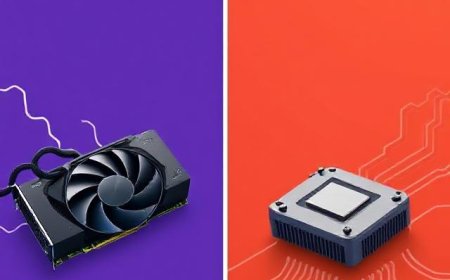
Introduction: More Than Just Gaming Power
When most people think of graphics cards—also known as GPUs (Graphics Processing Units)—they think of video games. And while it’s true that GPUs are essential to delivering high-fidelity graphics and smooth gameplay, their role in modern computing has grown far beyond gaming.
Today, GPUs power everything from AI training and data analysis to scientific simulations and blockchain mining. In fact, in many scenarios, a GPU can outperform a CPU by a significant margin.
In this comprehensive guide, we’ll explore how GPUs work, their applications, their key specifications, and how they’re shaping the future of computing.
1. What Exactly Is a GPU?
A GPU is a specialized electronic circuit designed to rapidly manipulate and alter memory to accelerate the creation of images and calculations. Unlike a CPU (Central Processing Unit), which handles a wide variety of general tasks, GPUs are optimized for parallel processing—meaning they can handle many tasks at once.
Originally developed to render 2D and 3D images efficiently, GPUs are now at the core of visual computing and high-performance computation.
2. A Quick Evolution of Graphics Cards
- 1990s: Basic 2D accelerators used in desktop computing
- Early 2000s: Rise of dedicated GPUs from NVIDIA and ATI (now AMD)
- 2010s: GPUs become programmable and used in professional applications
- 2020s: Massive growth in demand due to AI, machine learning, and metaverse
Today’s GPUs are incredibly complex, housing billions of transistors and often rivaling CPUs in computational power.
3. GPU vs. CPU: What’s the Difference?
Though both are processing units, their functions differ:
- CPU: Best at sequential processing and logic
- GPU: Designed for parallel processing, handling many operations simultaneously
This makes GPUs ideal for:
- Image and video rendering
- Deep learning computations
- Cryptocurrency mining
- 3D modeling and simulations
Simply put, when workloads require massive parallelization, GPUs are far more efficient.
4. Key GPU Specifications Explained
Understanding the following specs helps when comparing graphics cards:
- CUDA Cores / Stream Processors: The more, the better (generally).
- VRAM (Video RAM): Dedicated memory for textures and assets.
- Clock Speed: Determines how fast the GPU can process instructions.
- Memory Bandwidth: Affects how quickly data can be read/written.
- TDP (Thermal Design Power): How much heat it generates under load.
For gaming, higher VRAM and clock speeds usually translate to better performance. For AI or 3D rendering, more cores and memory bandwidth are crucial.
5. Types of GPUs: Integrated vs Dedicated
- Integrated GPUs are built into CPUs, suitable for everyday tasks and light graphics work.
- Dedicated GPUs are separate cards with their own VRAM and processing power, ideal for gaming, video editing, and heavy computations.
Dedicated GPUs offer significant advantages in performance but also consume more power and generate more heat.
6. Popular Brands and GPU Series
The market is dominated by two key players:
- NVIDIA: Known for GeForce (gaming), Quadro (workstation), and Tesla/A100 (AI-focused) cards.
- AMD: Offers Radeon GPUs for gaming and professional tasks.
NVIDIA’s CUDA architecture has made it the preferred choice in AI and scientific computing, while AMD’s open-source ROCm is gaining popularity.
7. GPU Use Cases Beyond Gaming
While gaming remains a major driver, GPU use has expanded into:
- Artificial Intelligence: GPUs train deep learning models faster than CPUs.
- Video Editing and Rendering: Real-time playback, faster exports.
- 3D Animation and CAD: Smooth workflows in tools like Blender, Maya, and AutoCAD.
- Cryptocurrency Mining: Solving cryptographic puzzles in blockchains like Ethereum (prior to the switch to PoS).
- Medical Imaging: Assisting in analyzing complex diagnostic scans.
Their parallel-processing nature allows GPUs to excel in any task involving large datasets and simultaneous calculations.
8. Cloud GPUs and Virtualization
Not everyone can afford a high-end GPU, especially for short-term tasks. Cloud providers like Google Cloud, AWS, and Microsoft Azure now offer GPU instances for rent, enabling:
- On-demand AI model training
- Scalable rendering solutions
- Virtual desktop environments for engineers and creators
This trend is democratizing access to GPU power.
9. Energy and Cooling Considerations
High-performance GPUs require significant cooling, especially under heavy load. Enthusiasts and professionals often use:
- Aftermarket air coolers
- Liquid cooling systems
- External GPU enclosures (eGPUs) for laptops
Power consumption is also a factor, with top-tier GPUs demanding 300–450W or more. It's essential to match a GPU with a sufficient power supply and ventilation system.
10. The Future of Graphics Cards
As demands for visual fidelity, AI power, and data analytics grow, GPUs will continue evolving:
- Ray tracing will become standard in real-time rendering.
- AI-enhanced upscaling (like NVIDIA DLSS) will make games look better at lower system costs.
- Unified memory systems may blur the lines between CPU and GPU memory.
- Multi-GPU setups and chiplet-based architectures could dominate the future.
Moreover, quantum GPU research is already underway, exploring new frontiers in how graphical and parallel computation could evolve.
Conclusion: The GPU as the Workhorse of Tomorrow
Graphics cards have moved far beyond their initial role as a tool for gamers. They’re now essential in nearly every high-performance computing scenario. From enabling cinematic visuals to unlocking breakthroughs in AI, the GPU has become the beating heart of modern machines.
Understanding how GPUs function, and what makes one better than another, empowers users—gamers, developers, researchers, and content creators alike—to make informed decisions and leverage the full potential of their computing environments.