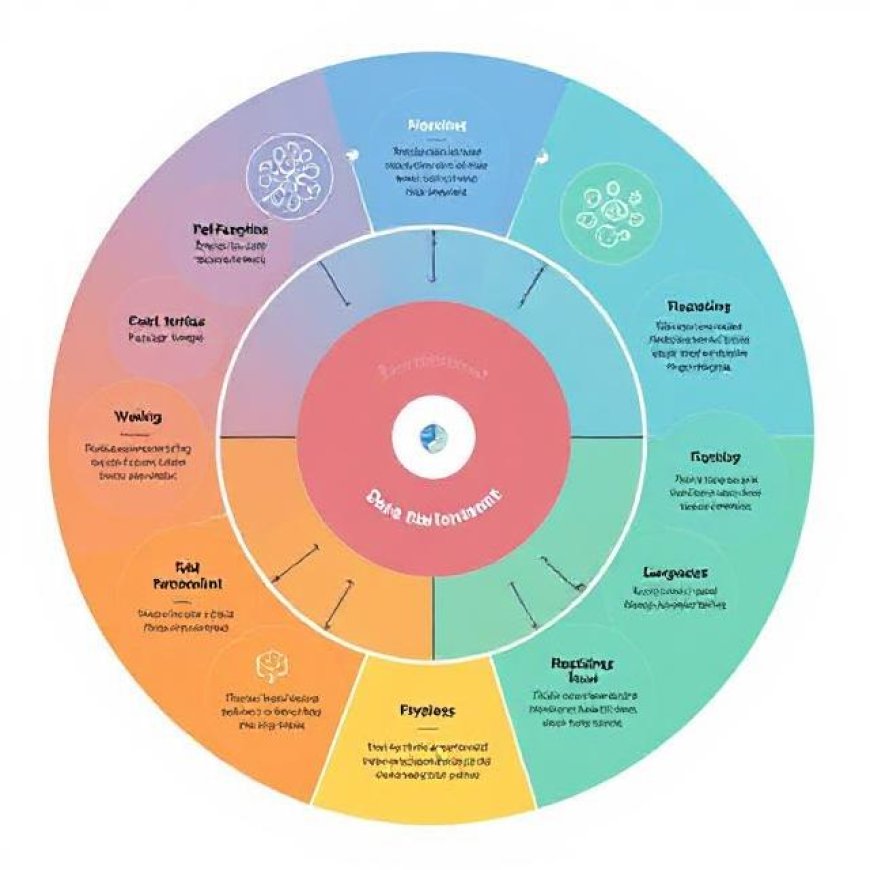

In the age of information, raw data alone has little value unless it is transformed into actionable insight. This transformation happens through a structured process known as the data science lifecycle. Whether you're building a recommendation engine, detecting fraud, or optimizing supply chains, understanding this lifecycle is key to delivering reliable, reproducible, and meaningful results.
In this comprehensive article, we break down each phase of the data science lifecycle—from problem identification to delivering insights—with examples, best practices, and insights into how top companies apply these methods at scale.
1. Understanding the Business Problem
Every successful data science project starts not with code, but with a question. Whether it's predicting customer churn or optimizing delivery routes, defining the problem in business terms is essential.
Key activities:
- Stakeholder interviews
- Identifying KPIs (key performance indicators)
- Setting project scope and objectives
Example:
An e-commerce company wants to reduce cart abandonment. The business question becomes: “What factors predict whether a customer will abandon their cart?”
2. Data Collection and Ingestion
Once the problem is defined, the next step is to gather relevant data. This can come from internal databases, third-party APIs, IoT sensors, web scraping, or public datasets.
Types of data:
- Structured (spreadsheets, SQL databases)
- Semi-structured (JSON, XML)
- Unstructured (text, images, video)
Data ingestion must ensure data freshness, completeness, and legality, especially with privacy laws like GDPR or CCPA.
3. Data Cleaning and Preprocessing
Raw data is often incomplete, inconsistent, or noisy. This phase involves transforming messy data into something usable.
Common preprocessing tasks:
- Handling missing values
- Removing duplicates
- Standardizing formats (e.g., date/time, currency)
- Outlier detection
- Encoding categorical variables
- Feature scaling and normalization
Tools used: Pandas, NumPy, SQL, Apache Spark, OpenRefine
This step can take up to 80% of a data scientist’s time but is crucial for accurate model performance.
4. Exploratory Data Analysis (EDA)
EDA helps uncover patterns, anomalies, and relationships in the dataset. It also guides feature engineering and model selection.
Key techniques:
- Summary statistics (mean, median, std dev)
- Data visualization (histograms, boxplots, scatterplots)
- Correlation matrices
- Distribution analysis
- Hypothesis testing
Example:
Visualizing customer age vs. purchase behavior may reveal that younger users abandon carts more often than older ones.
5. Feature Engineering and Selection
Features are the heart of machine learning models. Well-designed features can drastically improve model accuracy.
Steps include:
- Creating new variables from existing data
- Binning continuous variables
- One-hot encoding categorical variables
- Selecting the most relevant features using statistical tests, regularization, or tree-based methods
The goal is to reduce dimensionality while retaining predictive power.
6. Model Selection and Training
At this stage, data scientists select the right algorithm based on the problem type (classification, regression, clustering, etc.).
Common models:
- Logistic Regression
- Decision Trees & Random Forests
- Support Vector Machines
- Neural Networks
- Gradient Boosting (XGBoost, LightGBM)
The dataset is split into training, validation, and test sets. Cross-validation is often used to ensure robust performance.
7. Model Evaluation
Once trained, the model's performance must be evaluated using appropriate metrics.
For classification:
- Accuracy, Precision, Recall, F1 Score
- ROC-AUC curve
For regression:
- RMSE, MAE, R-squared
Key questions:
- Is the model overfitting or underfitting?
- How does it perform on unseen data?
- Are the results statistically significant?
Tools: Scikit-learn, TensorFlow, Keras, PyTorch, MLflow
8. Model Deployment and Monitoring
A high-performing model is only valuable when deployed to production. Deployment ensures the model serves real-time predictions or informs batch decision systems.
Methods:
- REST APIs for model serving
- Integration with business dashboards (e.g., Tableau, Power BI)
- Scheduled batch jobs
Monitoring involves:
- Detecting data drift
- Re-training models as needed
- Measuring real-world impact (e.g., revenue growth, cost savings)
9. Communicating Results
A critical yet often overlooked step is communicating insights in a clear, persuasive, and business-friendly manner.
Best practices:
- Use visuals to simplify complex data
- Translate technical results into actionable recommendations
- Tailor reports to the audience (executives, engineers, marketers)
Tools: Jupyter Notebooks, PowerPoint, dashboards, narrative storytelling
10. Feedback and Iteration
Data science is not a linear process. New data, changing business goals, or emerging technologies often require going back and revisiting earlier steps.
Agile methodologies and continuous improvement cycles ensure that models stay relevant and valuable over time.
Real-World Data Science Lifecycle Example: Predicting Flight Delays
Let’s apply the lifecycle to a practical problem:
- Business goal: Help travelers plan better by predicting delays.
- Data sources: Historical flight data, weather reports, airport traffic.
- Cleaning/EDA: Identify peak delay times and high-risk airports.
- Modeling: Train a random forest classifier on key features (departure time, airline, weather).
- Evaluation: ROC-AUC of 0.87 on test data.
- Deployment: Provide delay probabilities via a travel app API.
- Feedback: Regularly update the model with recent flights.
Challenges in the Data Science Lifecycle
- Access to quality data
- Aligning stakeholders on goals
- Time constraints and tight deadlines
- Regulatory hurdles (GDPR, HIPAA)
- Lack of interpretability in black-box models
Overcoming these requires technical skill, domain knowledge, communication abilities, and sometimes... patience.
The data science lifecycle is more than just a checklist. It's a dynamic, iterative process that requires collaboration, creativity, and precision. Mastering each phase enables data scientists to not only build better models but to solve meaningful problems that make a real-world difference.
Whether you're a beginner or a seasoned professional, embracing this lifecycle will elevate the impact and credibility of your work—and help unlock the full potential of data in any organization.